Your AI is only as good as your data
Ran an AI pilot that underwhelmed? The problem is rarely the model.

Article
6 min read
Last updated
June 4, 2026
2 of 8
parts
Ran an AI pilot that underwhelmed? The problem is rarely the model.

Most talent teams I speak to have now run their first real experiment with AI in hiring... and a lot of them came away underwhelmed.
The sourcing tool surfaced candidates that felt no better than before. The interview summaries missed the things that actually mattered. The shortlist looked plausible, but the correlation between the highest-scoring candidates and those who progressed furthest was weak.
And when all of that happens, the instinct is to blame the tool: "Maybe the next version will be smarter. Maybe a different vendor's AI is the one that finally works." So the team waits, or switches, and tries again in six months.
That instinct is usually wrong.
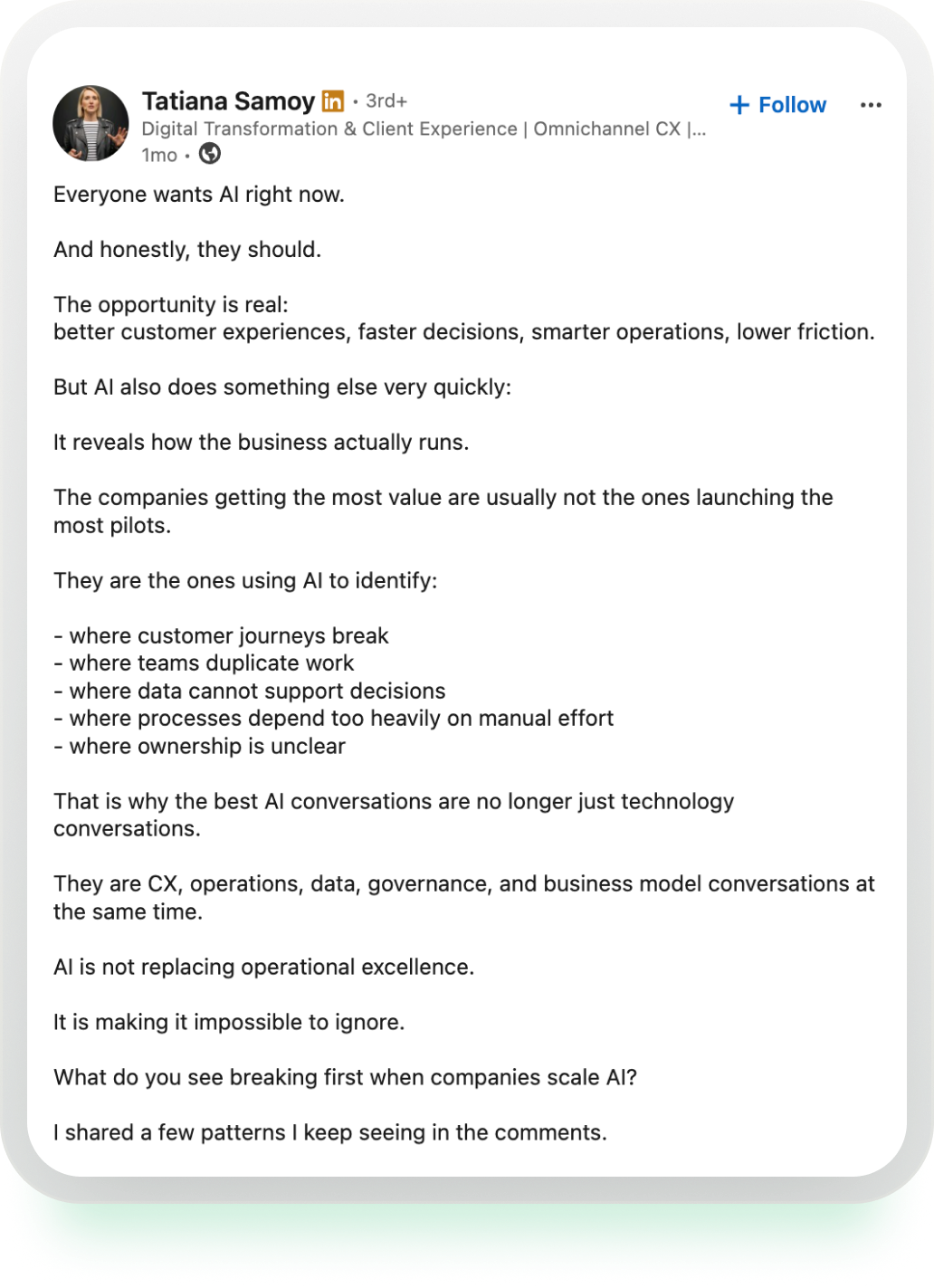
Tatiana Samoy captured this perfectly in her recent post: “AI reveals how the business actually runs.”
It doesn't impose a better process on you, it amplifies the one you already have: point it at a hiring source of truth where the information is complete and current, and it can do genuinely useful work. Point it at the more common reality, where half the story lives in inboxes and side conversations, and it amplifies the gaps with the same enthusiasm.
So the disappointing pilot is rarely a failure of intelligence. More often, it's a failure of inputs.
And when I say inputs, I don't mean the application form. I mean the real story of a hire: the feedback a manager typed in a hurry between meetings, the scorecard that says “strong” but not why, the quiet debate about two final candidates, the note that one of them interviewed badly but came highly recommended by someone you trust.
That messy, human material is what good hiring decisions are built from. It's also what a useful AI needs to reason about.
In most organizations, very little of that material lands in the system of record.
It scatters. Decisions go to email, and feedback happens in Slack, in Teams, or over a coffee in the kitchen.
The careers site, the scheduling tool, the assessment vendor, and someone's notes app each hold a fragment. The applicant tracking system ends up as a list of names and stages rather than a record of how the hiring actually happened.
Switch AI on over that, and it works with the half of the truth that made it into the system. Usually the tidy, structured half. However, the judgment and context, the why behind each decision, is the part that leaked out. And it's also the part you most wanted help with.
This gets harder the more shapes of hiring an organization runs. (I wrote about that in the first piece in this series.) A system built for corporate recruiting but not high-volume hiring, or for desk-based but not deskless workers, pushes the teams it doesn't fit out of the system. They build their own workarounds, and the data those workarounds generate never comes back.
The teams a system doesn't fit are the teams that route around it. Every workaround is another hole in the picture your AI is using to support decisions.
This isn't only our view. The Josh Bersin Company describes where fragmented hiring data ends up: siloed, duplicated, and obscuring the full picture, so leaders can't see what's really happening. Their term for the alternative is “systemic business analytics,” a single connected view an organization can actually reason over.
They point to Panasonic, which struggled with overhiring until it brought its hiring and workforce data together, saw the pattern it had been missing, and adjusted, improving retention and productivity as a result.
The lesson is a simple one. The value came from making the data whole, not from making the algorithm smarter.
That points to the precondition almost nobody puts on the AI shopping list.
For AI to help with hiring, it needs a complete, current, cross-stakeholder picture of what's happening: what every recruiter, hiring manager, and candidate is doing, close to real time, in one place. Not a sample. Not the structured leftovers. The actual process.
You only get that when the organization genuinely works in the system. When hiring managers leave feedback there instead of in a Teams thread. When recruiters run searches there instead of in a spreadsheet. When a candidate's journey, from first application to signed offer, lives in one record instead of five loosely connected tools.
That's why the thing being adopted is the platform, not the AI.
And this is the idea I want every leader to sit with, because it runs against the way the market talks. You don't start by adopting AI. You start by adopting a hiring platform that works for your whole organization.
A team that gets its hiring operation into one platform has, almost as a by-product, built the clean, comprehensive dataset that automation and AI depend on. A team that starts with AI on top of fragmented data has simply found a faster way to process an incomplete picture.
It's why two organizations can buy the same AI features and come away with completely different experiences. The difference often comes down to how much of the truth the software can see.
A complete picture pays off in two ways, and they reinforce each other.
The first is safety. AI you can't see into is a real risk in something as regulated and consequential as hiring. When the system holds the full record, the reasoning is anchored in actual activity, decisions are auditable, and teams can stand behind them. Blind spots are where bias and error tend to hide. A complete picture is how you close them, and how you scale AI across the organization without quietly scaling its mistakes alongside it.
The second is quality. Useful, personalized output depends on context. Give an AI the full history of a candidate, the role, and the way a particular team hires, and it can produce something worth acting on. Give it fragmented information and you get generic recommendations dressed up as insight. The quality of the output is limited by the completeness of the picture it's working from.
So if your first run at AI in hiring underwhelmed, I'd encourage you to resist the urge to go shopping for a smarter AI tool. The smarter tool will likely just amplify the same gaps, faster.
Ask the less glamorous questions instead. Are the right processes in place? Is the whole organization, across every team and every shape of hiring, working in one system? Is the data complete enough that you'd trust a decision made on top of it?
Get those things right and most of the AI value you're looking for becomes available. Skip them and no AI tool will close the gap.
We think about this a lot, for fairly obvious reasons: building the ATS is the day job. We didn't set out to bolt AI onto another applicant tracking system. We set out to build a system the whole organization will want to use, across every shape of hiring, because that level of adoption is what creates the clean, comprehensive data that automation and AI depend on.
Or, to put it the way we usually do: Pinpoint isn't just another ATS with AI. Pinpoint has invested heavily in creating the conditions under which automation and AI deliver.
Clever models are getting cheaper and better by the month. A complete, trusted picture of how your organization hires is the rare thing. And it's the thing that decides whether any of the rest of it works.
Tom is the CEO at Pinpoint, he's passionate about building world-class teams and world-class products for organizations around the world.